General
The sections in Settings' General group: your user, the company data, who works in it, where it serves from and how information is protected.
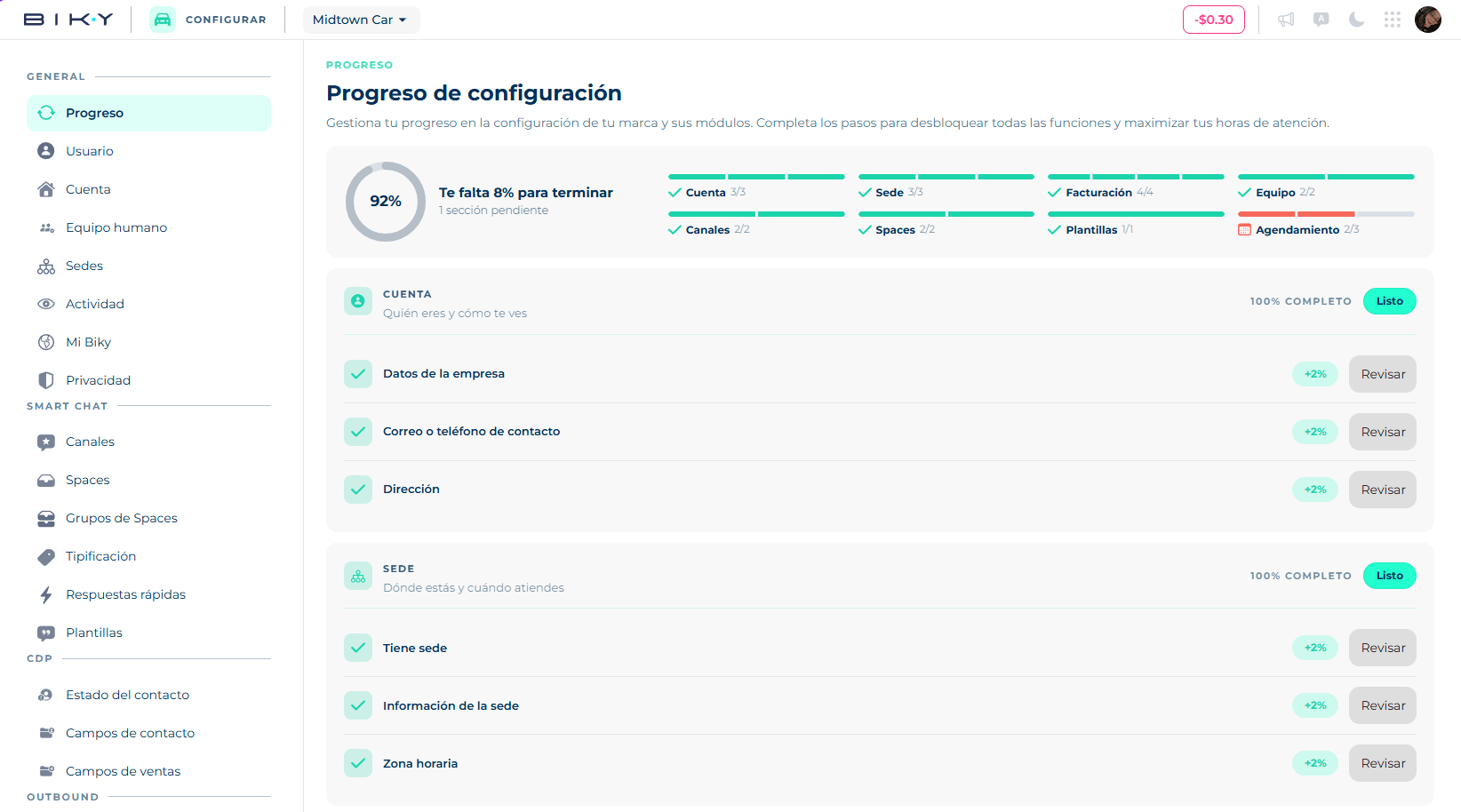
Progress
The landing screen. Manage your progress in configuring your brand and its modules. Complete the steps to unlock all features and maximize your service hours.
It shows a global percentage (You have 40% left · 5 pending sections) and eight groups, each with its progress:
| Group | What it covers |
|---|---|
| Account | Who you are and how you look: company data, contact email or phone, address. |
| Branch | Where you are and when you serve: having a branch, its information and the time zone. |
| Billing | So we can charge you without interrupting service: legal name and tax ID, billing address, active plan, billing contact. |
| Team | Who serves with you: having members and them having a role. |
| Channels | Where people write you from: connect at least one channel. |
| Spaces | How conversations are distributed: active inbox and agents in the inbox. |
| Templates | The messages you open conversations with: having a Meta-approved template. |
| Scheduling | So people can book without writing you: active advisors, active schedules, synced calendar. |
Each task shows how much it adds to the percentage and a button: Complete if missing, Review if done. Pending ones explain why they matter (Without connected channels Biky has no conversations to handle) and exactly what is missing (Missing: WhatsApp). When a group reaches 100%, it is marked Ready.
Start with Channels
Groups do not weigh the same. Channels is worth 10% per task and is the biggest blocker. Then Scheduling (8% per task) and Billing (5%).
User
User preferences — Manage your profile, language, security and usage preferences.
This is your personal configuration, not the company's: it affects only you.
| Block | What it holds |
|---|---|
| Account | Personal information (your data and photo) and Password. |
| Preferences | Platform Language, Mode (light or dark) and notification Sound. |
| Security | Connection history: where and when your user was signed in from. If you see an access you do not recognize, change the password. |
| Smart Chat | My quick replies: your own, on top of the ones the account shares. |
Account
Company preferences — Configure your brand information to improve your experience in Keybe.
The company data. It is what the agent uses to know whose name it speaks in, and what sets the defaults for the whole operation.
- The brand's profile picture and Account name (required), Company name and Description.
- Contact Email (required) and Phone.
- Time zone (required): service hours and Calendar appointments depend on it.
- Currency (required): the one Catalog prices and Funnels amounts are shown in.
- Language, Country code and Country (required).
- App UUID and Categories: your account's identifier and its KB System. Not edited here; Keybe sets them.
Time zone and currency are set once
Changing the time zone shifts how every schedule already loaded is read, and changing the currency does not convert existing amounts. Get them right from the start.
Team
The Team list: the people working in the account.
- Two tabs: Active accounts and Inactive accounts.
- Invite to team adds someone new: they get an email to complete their registration.
- The table shows Name, Phone, Type and Status, with a switch to activate or deactivate the person and an icon to delete them.
- The See permission types link opens the detailed explanation of each role.
Deactivating someone who leaves beats deleting them: it keeps the history of their conversations and sales.
How to add someone to the team
Inviting is one click; what decides whether the person can actually work are the three steps that come after. An invitation with no type and no spaces leaves someone staring at an empty screen.
- Invite the team and enter their email. They get a message to complete their registration; until they do, they show up as pending.
- Assign their Type. That is the permission: it decides what they see and what they can do. The table below spells out each one's scope.
- Switch on the Spaces they will have access to, in the block at the end of the form. This is the step that gets forgotten most, and without it the person sees no conversations at all.
- Pick their Position, which describes their actual job and grants no permissions.
- If it applies, turn on Read only or Assistant mode.
When someone leaves, deactivate them with the switch instead of deleting them: it keeps the history of their conversations and their sales.
Type: what each person can do
The Type field is the role, and it decides what the person sees and can do:
| Type | Scope |
|---|---|
| Agent | Serves customers. Sees their own conversations and works within the spaces assigned to them. Does not see anyone else's operation. |
| Coordinator | Supervises a team. Sees the conversations of their spaces, can transfer between advisors and sees their group's metrics. |
| Trainer | A profile focused on training the AI agent: reviews conversations and works on what needs correcting. |
| Admin | Runs the whole account: settings, team, channels, billing and every space. |
| Account Manager | Account management profile. |
| Owner | The account's owner. |
There are also three switches when editing a member:
- Read only: can come in and look, but not change anything.
- Is owner: marks them as the account's owner.
- Assistant mode: enables the agent's assistant mode for that person.
And below, the Spaces block, where you turn on one by one which ones they can access.
The role is not a detail
Getting the Type wrong is the most common cause of "nothing shows up for me" — an agent nobody assigned spaces to sees an empty inbox — or of someone seeing what they should not. Check it before the person starts working, not after.
Position: the actual job, by industry
Position is different from Type: it grants no permissions, it describes the job the person holds in your company, and the list of options changes with the account's KB System.
In an automotive account, for instance, the options are a dealership's: Sales advisor, BDC coordinator, Brand director, F&I, Sales manager, Used-car manager, General manager, Marketing manager, Administration manager, HR manager, Corporate governance and Other. In another industry's account, the list is that industry's.
Digital or floor
In automotive accounts every advisor also carries an agent type:
| Agent type | Who they are |
|---|---|
| Digital | Serves by chat, from the platform. |
| Floor | Serves in person at the dealership, on the sales floor. |
The distinction is not cosmetic: it is a filter of its own in Metrics, and the advisor performance tables tag each one with their type. Comparing a floor advisor's time to first reply against a digital one's says nothing; separating them does.
This field is not edited from the member form: Keybe sets it along with the rest of your industry's parametrization. If an advisor is classified as the wrong type and comes out looking bad in the reports because of it, ask your Keybe contact to fix it.
Branches
Company branches — Manage your physical branches: set their location and service hours.
Each branch has a location, time zone, schedules and labels. These are the ones offered when booking an in-person appointment, and the ones the agent filters when the matching skill is on.
- Branch list: search box, count and Create branch. The table shows Name and Labels.
- Branch import: to load many at once, if you run a large network.
Activity
User activities — Check the recent changes made by your team: updates, actions and owners.
The account's audit log: what was changed, by whom and when. Filtered by Module, Action, Owner, Severity and Date range, with a search box.
This is where you go when something stopped working overnight and nobody knows why.
My Biky
Company microsite — Design a microsite for your account with links to social media, custom buttons and direct access to your catalog.
A mini web page for your brand, hosted on its own address like yourbrand.biky.app. It works as the single link for an Instagram bio, a QR code or an email signature.
You build it with: the URL, a Title and Subtitle, the Logo, a Color, the Biky image, the channel the main button leads to, and whatever buttons you add with Add button (social media, catalog, anything).
Privacy
Contact information privacy — Configure your database's privacy.
Controls who can see and take your contacts' personal data. Three settings:
| Setting | What it does |
|---|---|
| Block right-click copy | Prevents copying contact data from the interface. |
| Protected data display | Only allows seeing the data of the selected person, not the whole list at once. |
| Block contact information by role | Choose who sees contact information in CDP and Smart Chat: All roles, Administrators only, or Administrators and coordinators. |
The section includes a What is Habeas data? link explaining data processing consent, which is what the agent asks for when starting a conversation if it is enabled in Biky admin.
This is not paranoia
A team with high turnover and full access to phones and emails is the most common way a database ends up with the competition. If your operation uses temporary agents, restrict by role.